Exercise Like A Wild Thing
If exercise was bad for you, everyone would do it

Imagine a product that releases dopamine, serotonin, GABA and endocanniboids, affects the brain in ways similar to alcohol, improves your sleep quality, increases cognitive processing, and reduces chronic pain. It makes food taste better and improves sexual satisfaction and body image. You can customize your dosage and still get the neurochemical benefits. It is safe, legal, affordable, widely available, and can be enjoyed socially or solo. You begin experiencing the benefits right away, and it just gets better from there. Sounds pretty damn good, huh?
This is not an ad for a supplement. The feel-good wonder drug I’m talking about is physical activity, or as we often call it, exercise. I know what you’re thinking. “Nice try, exercise is a virtue, not a vice; this is like when they tried to tell us kale is delicious.” 🥬
Hear me out though - what if we’re thinking about exercise the wrong way?

When you think about all the ways that moving your body makes you feel good, it’s shocking that physical activity has gotten such a goody-goody reputation. Exercise is a hedonistic, self-indulgent pursuit. You’re sweating and connecting with the sensations of your own muscles, moving as quickly or slowly as you want. Variations of intensity make physical activity a complex and lush experience, a feast for the senses. It is so deeply carnal and primitive that it should feel like a forbidden pleasure.
And it was forbidden for women in the 1800s, when exercise was considered unladylike, and the bicycle was called “the devil’s advocate.” I’m grateful to live in a world where no one accuses me of immorality because I’m riding a bike. But we should remember that the present reputation of exercise as morally good is a recent phenomenon. How insane is it that women today are told exercise is an obligation, when our great-grandmothers had to fight for the right to break a sweat? Bonkers.
Sometimes people have reduce their exercise for a while because of injury, illness and eating disorder recovery. The reality is that exercise can be very hard to stop, even when it’s contraindicated. Like anything that makes you feel good, exercise can be addictive. Public health downplays exercise’s addictiveness because it goes against it’s image as purely health-supporting, like tooth care and lab work. But exercise is not a dental cleaning. The true appeal of exercise is in the way it makes you feel.
Yes, exercise can reduce your risk of multiple chronic diseases, but so can wine, and no one is guzzling merlot for their health. Unlike the wine industry, which makes a nod to health benefits but is well aware that their appeal is making the good times roll, marketing for exercise mostly focuses on disease prevention and body size manipulation (yuck). Promoting exercise as a means to an end, instead of a wild and sensual experience, ignores the reason why most people exercise consistently: because they enjoy it.

For an excellent example of how sexy exercise is, see Pitbull’s music video for “Work” (above)
Why does it matter how we talk about exercise?
This recent rebrand of exercise as wholesome and healthful has been largely ineffective and offputting. There is a limit to what infographics about ‘staying active for a healthy heart’ can do. Reactance theory explains that being told to do something make us want to do it less, and research has shown this also applies to health-focused messaging about exercise. Public health is just barely catching onto this, and only because fifty years of developing guidelines and promoting exercise as a ‘healthful choice’ has been a huge failure from an engagement standpoint.
People don’t want to do things that are good for them, they want to do things that feel good to them. Exercise is supposed to feel good, but public health has spent half a half a century lumping it in with “health-promoting behaviors” like colonoscopies, beta blockers and eating leafy greens. This is the wrong category for something so natural that neanderthals did it. And then there’s the most obvious problem with how we talk about exercise, the one I’m literally out here Substacking to address…
But but but …my butt!
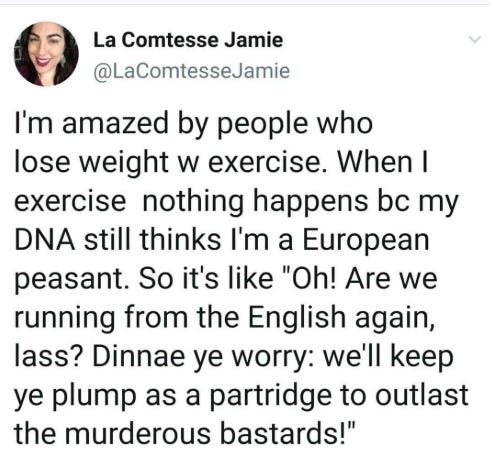
One of the biggest reasons exercise has a party-pooper reputation is the false belief that exercise inherently makes people lose weight or look more muscular. This is the whole “oh I have to run an extra mile because I had a slice of cake” garbage. The reality is much more complicated. Exercise affects people’s body composition differently, as the tweet above so succinctly expresses.
People are very physically active at all different weights, because people are supposed to be all different sizes. That’s why we have professional ice skaters, dancers, powerlifters, fitness instructors and rock climbers in fat* bodies. All bodies, no matter their size, benefit from exercise. The myth that exercise shrinks people has caused so much damage to our relationship with physical activity. It’s reduced a primal human urge to an exchange rate calculation. Exercise is not supposed to be a sacrifice, it is supposed to be a joyful experience.
So why are we talking about exercise like it sucks?
A review of what we’ve covered so far: Our brains and bodies are hard wired for movement to feel good. The moralization of exercise as virtuous is a recent phenomenon, and it doesn’t mesh with reality. Human psychology predisposes us to resist things we are supposed to do, which is why public health campaigns have failed to help people become more active. The myth that exercise causes weight loss is sucking the joy out of physical activity. We’ve taken one of the most incredible gifts of our biology and turned it into another way to be miserable. What does this mean for all of us as individuals?
Each of us has a choice, every day, and every time we think or talk about physical activity. We don’t have to refer to exercise as an obligation or a virtue. Instead, we can recognize that humans are built to move, and that exercise lights up the same regions of the brain as alcohol, drugs and sex because our bodies are meant to experience movement as a pleasurable and joyful. We could talk about exercise as indulgence, like chocolate, good music and laughing with friends. Or we could even talk about exercise as a rebellion, a revolt against the forces telling us to be quiet, sit still and take up less space.
And you know what? I bet if we stopped talking about health and started talking about delight, exercise would get a lot more popular. Because physical activity is a deeply human experience, a connection to our animal spirits and an opportunity to set loose the untamed being within us. So with that I say:
Go ahead and have fun moving your body, you wild thing!

*I use fat as a neutral description, like short or tall.
Yeeeah baby. I often think about how ridiculous and stilted our mainstream view of exercise has become. We have these bodies built to move and wired to enjoy it, but we’re stuck picturing peak fitness only happening in sterile gyms for 60 minutes before going back to sitting down for most of the day.
I love this, thank you for sharing! Recently I joined a new yoga studio and was talking to someone about it and they said something like "I wish i could do yoga, is it good for weight loss?" I wanted to shake them!